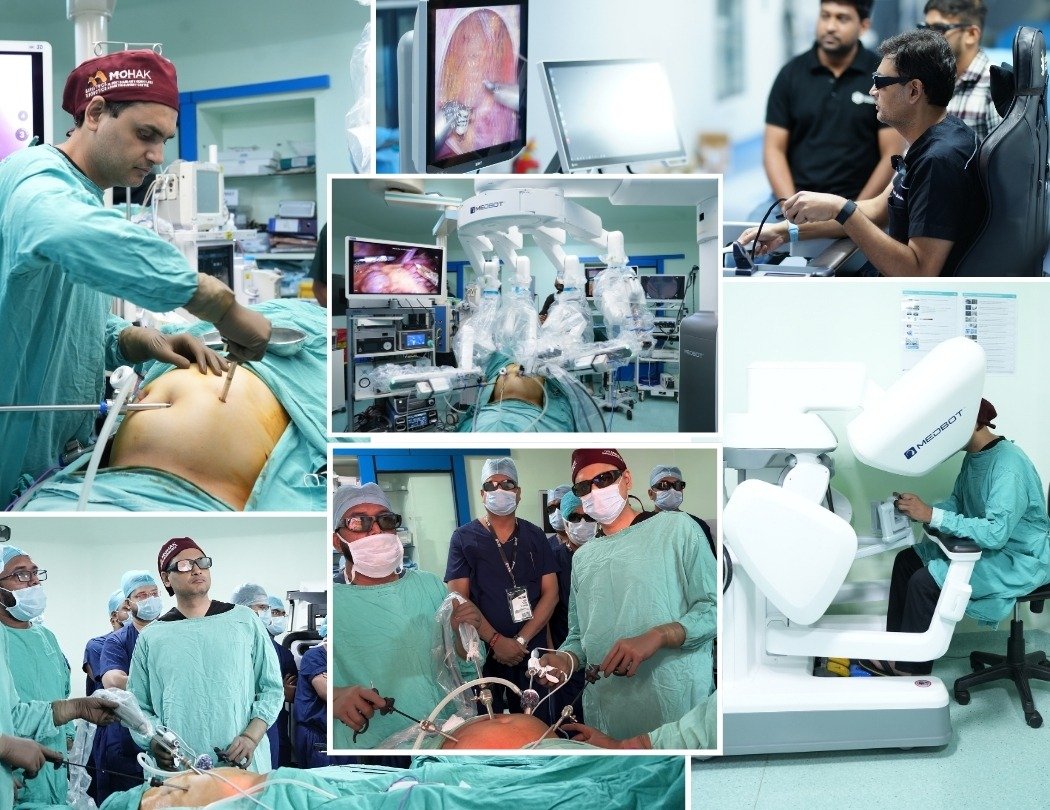
How Is Technology Transforming Hernia Repair Surgery?
For decades, hernia repair surgery followed a fairly standard approach. Surgeons made large incisions to access the affected area, manually repositioned the protruding tissue, and repaired the defect using sutures. While these procedures were effective, they often resulted in significant pain, longer hospital stays, visible scars, and an increased risk of recurrence.
Today, we are witnessing a remarkable transformation in hernia surgery. Thanks to advances in minimally invasive techniques, robotic technology, artificial intelligence, and telerobotics, hernia repair has become more precise, less traumatic, and significantly more patient-friendly than ever before.
As a Laparoscopic, Bariatric & Robotic Surgeon, I have had the opportunity to experience this evolution firsthand. Technology is no longer just supporting surgery; it is redefining how we diagnose, plan, and perform hernia repairs.
From Large Incisions to Minimally Invasive Surgery
The abdominal wall is a complex structure made up of muscles, connective tissue, nerves, and blood vessels. Traditional open surgery required large incisions to provide direct access to the hernia defect. While effective, this approach inevitably caused damage to healthy tissue, resulting in greater pain and longer recovery times.
Minimally invasive surgery changed this paradigm completely.
Instead of large cuts, surgeons now use tiny incisions, typically between 5 and 12 millimeters, through which specialized instruments and cameras are inserted. This allows us to repair the hernia while minimizing trauma to surrounding tissues.
For patients, the benefits are substantial:
- Smaller scars
- Reduced post-operative pain
- Lower risk of infection
- Shorter hospital stays
- Faster return to normal activities
The Impact of Laparoscopic Hernia Surgery
Laparoscopic surgery was the first breakthrough in minimally invasive hernia repair.
Using a laparoscope, a thin camera inserted through a small incision, surgeons can visualize the internal anatomy on a monitor and repair the hernia through tiny access ports.
Laparoscopic surgery remains an excellent option for many patients, particularly those with bilateral inguinal hernias or recurrent hernias. It allows multiple defects to be treated through the same small incisions while significantly reducing recovery time compared to traditional open surgery.
However, laparoscopy also has limitations. The instruments are rigid, depth perception can be challenging with conventional 2D imaging, and complex suturing may require advanced surgical expertise.
These limitations paved the way for the next major innovation: robotic surgery.
Robotic Surgery: A New Standard of Precision
Robotic-assisted surgery represents one of the most significant advancements in modern hernia repair.
Contrary to common misconceptions, the robot does not perform the surgery independently. Instead, it acts as an advanced extension of the surgeon's hands, translating every movement with extraordinary precision.
During robotic surgery, I operate from a dedicated console that provides a magnified, high-definition 3D view of the surgical field. Robotic instruments offer wrist-like articulation that far exceeds the range of traditional laparoscopic instruments, allowing us to work with remarkable accuracy in confined spaces.
This technology offers several advantages:
- Enhanced 3D visualization
- Superior dexterity and precision
- Tremor filtration
- Improved suturing capabilities
- Better preservation of healthy tissues
For patients with large ventral hernias, recurrent hernias, or complex abdominal wall defects, robotic surgery allows us to perform advanced reconstructions through minimally invasive techniques that were previously possible only through open surgery.
The result is often less pain, quicker recovery, and improved long-term outcomes.
The Rise of Telerobotic Surgery
One of the most exciting developments in healthcare today is telerobotic surgery.
This technology enables a surgeon to operate remotely using advanced robotic systems connected through high-speed communication networks. While still an emerging field, telerobotics has the potential to revolutionize access to specialized surgical care.
Imagine a patient living in a remote area who requires expert hernia surgery. Instead of traveling hundreds of kilometers to a specialized center, advanced telerobotic systems could eventually enable expert surgical care to reach patients while they remain close to home.
As communication technologies continue to improve, I believe telerobotics will play an increasingly important role in reducing healthcare disparities and expanding access to world-class surgical expertise.
Artificial Intelligence and the Future of Hernia Surgery
Technology is transforming not only how we perform surgery but also how we plan it.
Artificial intelligence is increasingly being used to analyze CT scans and imaging studies, helping surgeons create highly detailed 3D maps of the abdominal wall before entering the operating room.
This allows us to:
- Better understand complex anatomy
- Plan surgical strategies more effectively
- Select optimal mesh placement
- Anticipate potential challenges
Future AI systems may even assist surgeons in real time by identifying critical structures such as nerves and blood vessels, enhancing both safety and precision.
Smarter Mesh Technology
The evolution of mesh technology has also played a crucial role in improving outcomes. Modern meshes are lighter, more flexible, and increasingly biocompatible. Some next-generation biomaterials are designed to serve as temporary scaffolds that support healing before being gradually absorbed by the body.
These innovations reduce chronic discomfort, improve tissue integration, and contribute to better long-term results for patients.
Looking Ahead
Technology has transformed hernia repair from a highly invasive procedure into a sophisticated, precision-driven specialty. From laparoscopic and robotic surgery to artificial intelligence and emerging telerobotic platforms, innovation continues to redefine what is possible in patient care.
As surgeons, our focus remains unchanged: delivering safer procedures, faster recovery, and better long-term outcomes. The future of hernia surgery is not just about advanced technology; it is about improving lives. As Dr. Mahak Bhandari, I believe we are only beginning to unlock the true potential of these advancements, and the future of hernia care has never been more promising.