Which Hernia Repair Surgery Is Right for You?
Being diagnosed with a hernia often brings a series of questions and concerns. One of the most common questions I hear from patients is, “Which type of hernia surgery is best for me?” With rapid advancements in medical technology, patients today have access to more treatment options than ever before, including laparoscopic, robotic, and the emerging field of telerobotic surgery.
While all three approaches are designed to repair a hernia safely and effectively, the right choice depends on several factors, including the type and complexity of the hernia, prior surgeries, and the patient's overall health. As a Laparoscopic, Bariatric & Robotic Surgeon, I believe that understanding these options helps patients make informed decisions and approach surgery with greater confidence.
Understanding the Evolution of Hernia Surgery
For decades, hernia repair was performed through traditional open surgery. This approach required large incisions to access the weakened area of the abdominal wall and repair the defect directly. Although effective, open surgery often resulted in significant pain, visible scarring, longer hospital stays, and extended recovery periods.
Today, the landscape of hernia surgery has changed dramatically. Advances in minimally invasive techniques have enabled surgeons to repair hernias through small access points using sophisticated imaging systems and specialized instruments. This approach minimizes trauma to healthy tissues while improving recovery and overall patient outcomes.
As technology has evolved, three major approaches have emerged in modern hernia care: laparoscopic surgery, robotic-assisted surgery, and telerobotic surgery.
Laparoscopic Hernia Surgery and the Rise of Minimally Invasive Care
Laparoscopic surgery marked a major milestone in the treatment of hernias. By introducing a tiny camera through a small incision, surgeons gained the ability to visualize and repair hernias without creating large surgical wounds.
During a laparoscopic procedure, specialized instruments are inserted through small ports in the abdomen. The surgeon repairs the hernia and places a reinforcing mesh while viewing the surgical field on a monitor.
The greatest advantage of laparoscopic surgery is its ability to reduce tissue damage. Patients generally experience less post-operative pain, smaller scars, lower infection risks, and a faster return to normal activities compared to traditional open surgery. It is especially effective for bilateral inguinal hernias and recurrent hernias, where multiple defects can often be addressed through the same small incisions.
Even today, laparoscopic surgery remains an excellent option for many straightforward hernia cases. It is safe, reliable, and widely available. However, as surgical demands became more complex, new technologies were developed to enhance precision and overcome some of the limitations of conventional laparoscopy.
How Robotic Hernia Surgery Enhances Precision and Control?
Robotic-assisted surgery represents one of the most significant advancements in modern hernia repair. Despite the name, the robot does not operate on its own. Every movement is fully controlled by the surgeon through an advanced console.
The robotic platform provides a magnified three-dimensional high-definition view of the surgical field, offering superior visualization of delicate structures. Unlike traditional laparoscopic instruments, robotic instruments feature wrist-like articulation that allows them to move with remarkable flexibility and precision inside the body.
This enhanced control enables surgeons to perform complex suturing and abdominal wall reconstruction with greater accuracy. As a result, robotic surgery has become particularly valuable for patients with large ventral hernias, incisional hernias, recurrent hernias, and complex abdominal wall defects.
One of the most important advantages of robotic surgery is its ability to combine minimally invasive access with advanced reconstructive capabilities. This often translates into reduced post-operative pain, shorter recovery periods, lower dependence on pain medication, and improved long-term outcomes.
For many patients with complex hernias, robotic surgery offers a level of precision that was previously difficult to achieve through minimally invasive techniques.
Telerobotic Surgery and the Future of Accessible Healthcare
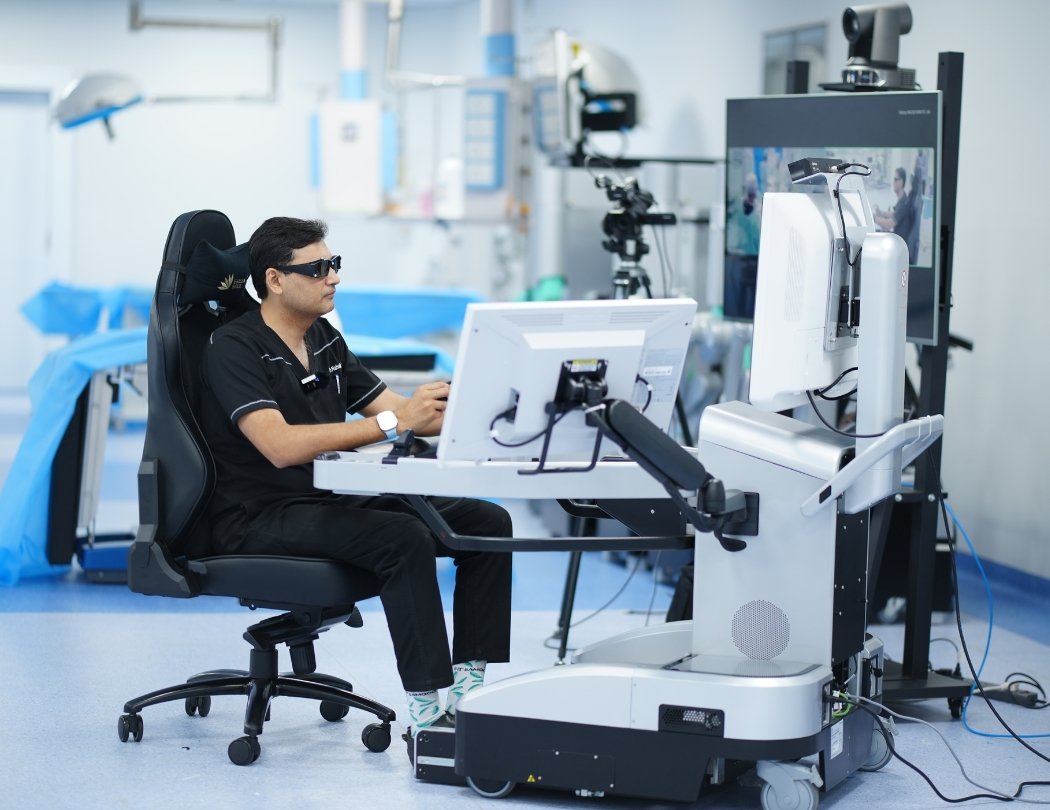
One of the most exciting developments in modern medicine is telerobotic surgery. While robotic surgery requires the surgeon to be present in the same operating room, telerobotic surgery allows the surgeon to operate remotely using advanced robotic systems connected through high-speed communication networks.
In practical terms, this means that a specialist surgeon can perform a procedure while being located hundreds or even thousands of kilometers away from the patient.
Although still an evolving technology, telerobotic surgery has the potential to transform access to specialized healthcare. Many patients living in smaller cities or remote regions face challenges when seeking expert surgical care. In the future, telerobotic platforms may help bridge this gap by bringing specialist expertise directly to local healthcare facilities.
As communication networks, robotics, and artificial intelligence continue to advance, telerobotic surgery is expected to play a major role in making high-quality surgical care more accessible across the world.
The Growing Role of Artificial Intelligence in Hernia Surgery
The future of hernia surgery extends far beyond robotic instruments. Artificial intelligence is increasingly becoming an important tool in surgical planning and decision-making.
Modern AI-powered systems can analyze CT scans and imaging studies to create highly detailed three-dimensional models of a patient's abdominal wall. This allows surgeons to evaluate the anatomy more accurately, identify potential challenges before surgery, and develop a personalized treatment strategy.
Artificial intelligence is also being explored for its ability to assist surgeons during procedures by identifying critical structures such as nerves and blood vessels. These innovations have the potential to further improve surgical safety, precision, and patient outcomes.
As AI technology continues to mature, it is expected to become an increasingly valuable component of modern hernia care.
Which Hernia Repair Surgery Is the Best Choice for You?
There is no single surgical approach that is ideal for every patient. The best option depends on the type and size of the hernia, whether it is a first-time repair or a recurrent condition, and the complexity of the reconstruction required.
For many uncomplicated hernias, laparoscopic surgery remains an excellent and highly effective option. Patients with larger or more complex hernias may benefit from the enhanced precision and reconstructive capabilities offered by robotic surgery. Telerobotic surgery, while still developing, represents a promising future in which geographical location will no longer be a barrier to receiving expert care.
The most important step is to have a detailed discussion with your surgeon, understand your specific condition, and choose a treatment plan that aligns with your individual needs.
Looking Ahead
Choosing the right hernia repair is not about selecting the newest technology. It is about choosing the approach that offers the safest procedure and the best long-term outcome for each patient.
Over the years, I have witnessed remarkable advancements in hernia surgery. From laparoscopic and robotic techniques to artificial intelligence and emerging telerobotic platforms, innovation continues to improve the way we diagnose, plan, and perform hernia repairs.
As Dr. Mahak Bhandari, I believe the future of hernia surgery lies in combining technological excellence with patient-centered care. Our goal is not simply to adopt advanced tools, but to use them thoughtfully to reduce pain, accelerate recovery, improve outcomes, and help patients return to healthier lives. The possibilities ahead are incredibly exciting, and we are only beginning to realize their full potential.
Ready to Discuss Your Hernia Treatment Options?
Every hernia is different, and the right surgical approach depends on your unique condition and medical history. If you're experiencing symptoms of a hernia or have been advised to consider surgery, schedule a consultation with Dr. Mahak Bhandari to discuss which repair option is best suited for you.