


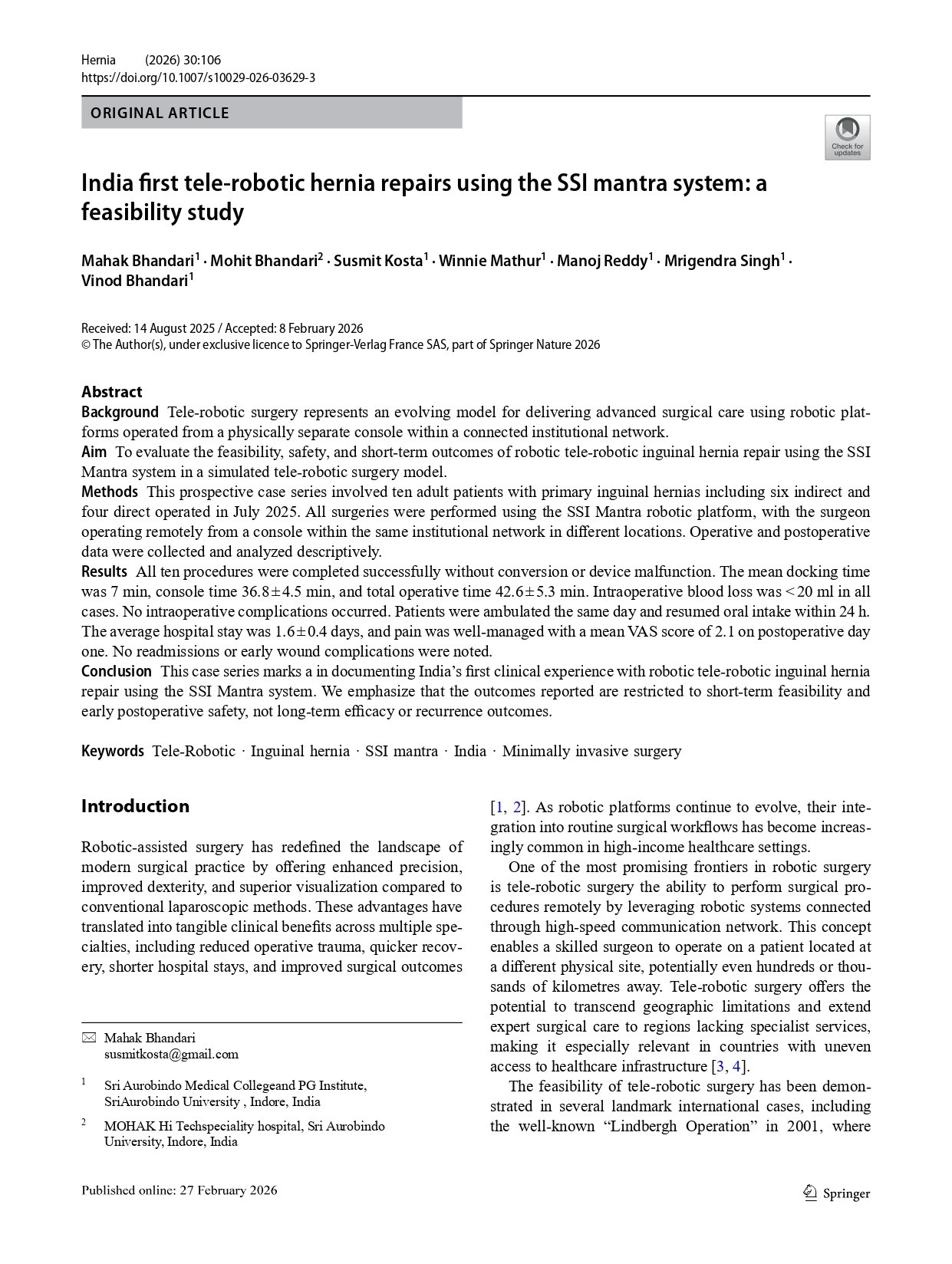
Dr Mahak Bhandari’s Tele Robotic Hernia Repair Published in Springer Nature
In a landmark achievement for Indian surgical innovation, a study published in Springer Nature reports the country’s first clinical experience of tele robotic inguinal hernia repair using the indigenous SSI Mantra robotic system. Led by Dr. Mahak Bhandari and his team, this pioneering feasibility study highlights the transformative potential of tele robotic surgery in improving access to advanced surgical care across India.
Tele robotic surgery represents a significant evolution in modern surgical practice, enabling surgeons to perform procedures remotely through advanced robotic platforms connected via high speed networks. This technology has the potential to bridge the gap between urban centers of excellence and rural or underserved regions, where access to specialized surgical expertise remains limited. In a country like India, where healthcare disparities are a major concern, such innovations are both timely and impactful.
The study, conducted in July 2025, involved ten adult patients diagnosed with primary inguinal hernias, including both direct and indirect types. All surgeries were carried out using the SSI Mantra system in a simulated tele robotic setting. In this model, the operating surgeon controlled the robotic console remotely within the same institutional network, while the patient remained in the operating room. Each procedure followed a standardized robotic transabdominal preperitoneal (TAPP) approach, ensuring consistency and precision across all cases.
The results of the study demonstrated excellent feasibility and safety outcomes. All ten procedures were completed successfully without any need for conversion to open or conventional laparoscopic surgery. There were no instances of device malfunction or technical failure. The mean docking time was approximately 7 minutes, while the average console time was 36.8 minutes and total operative time was 42.6 minutes. Blood loss was minimal in all patients, and no intraoperative complications were reported, underscoring the reliability of the system and the effectiveness of the surgical approach.
Postoperative recovery outcomes were equally encouraging. Patients were mobilized on the same day of surgery and were able to resume oral intake within 24 hours. The average hospital stay was 1.6 days, reflecting the minimally invasive nature of the procedure. Pain levels were well controlled, with low postoperative pain scores recorded across the cohort. Importantly, there were no early postoperative complications, wound related issues, or readmissions during the follow up period.
The study also emphasizes the advantages of the SSI Mantra system, India’s first domestically developed robotic surgical platform. Designed to be cost effective and compatible with existing operating room infrastructure, it incorporates advanced features such as three dimensional visualization and enhanced instrument dexterity. These capabilities make robotic surgery more accessible and scalable across diverse healthcare settings in India.
This work builds upon the global evolution of tele surgery, first demonstrated during the historic Lindbergh Operation, and adapts it to the Indian healthcare ecosystem. By establishing that tele robotic surgery can be safely and effectively performed within a connected network, this study lays the groundwork for future long distance surgical applications.
While the findings are currently limited to short term feasibility and early clinical outcomes, they represent a crucial step forward. Dr. Mahak Bhandari’s contribution reflects India’s readiness to embrace next generation surgical technologies. As digital infrastructure continues to advance, tele robotic surgery holds immense promise in expanding high quality surgical care to remote and underserved regions, ultimately redefining the future of healthcare delivery in India.
View Article